
Last Updated: November 22, 2026
Quick Summary
Red light therapy is a non-invasive treatment that may support collagen production, wound healing, pain relief, and inflammation control, with side effects that are usually mild, such as temporary redness. It cannot replace medical treatment for disease, and results depend on correct wavelength and dose.
- Red light sits around 630 to 660 nanometers, while near-infrared runs from roughly 800 to 850 nanometers.
- Dose combines irradiance and exposure time, so chasing the highest power setting without shortening sessions causes irritation.
- Stop if you notice blistering, lasting pain, or skin that stays red for more than a day.
- People on photosensitizing medications or with a history of skin cancer should get a clinician’s sign-off first.
- A mask suits facial skin concerns, while a full-body panel or bed covers joints, muscles, and the whole body.
Table of Contents
- How Red Light Therapy Works and What It Can and Cannot Do
- Red Light Therapy Risks and Benefits for Skin
- Benefits Beyond Skin: Pain, Inflammation, and Tissue Repair
- Side Effects and Safety: What Can Actually Go Wrong
- Who Should Avoid Red Light Therapy
- Red Light Therapy at Home: Devices, Dose, and What to Check
- Red Light Therapy Mask vs Full-Body Panel: Which Fits Your Goal
- Weighing the Pros and Cons Before Your First Session
- Frequently Asked Questions
How Red Light Therapy Works and What It Can and Cannot Do
Red light therapy is a non-invasive treatment that uses specific wavelengths of light to stimulate cellular activity. It is best understood as light that reaches your cells and supports their natural energy production, not as a cure for everything. (Source: research published in the Journal of Cosmetic Dermatology)
Here is the short version. Red light and near-infrared light penetrate the skin and reach the mitochondria, the part of the cell that makes energy. The proposed result is more cellular energy, which may support repair and inflammation control. The limits matter just as much.
Red light therapy cannot replace medical treatment for disease. It should not be relied on as the sole treatment for injuries or severe skin conditions. Think of it as a supportive tool, not a magic switch.
Wavelengths, Dose, and Why They Decide the Outcome
Wavelength is the single biggest factor in whether a session does anything at all. Red light sits around 630 to 660 nanometers. Near-infrared light runs from roughly 800 to 850 nanometers and reaches deeper tissue.
Dose is the second factor. Dose combines how strong the light is (irradiance) with how long you expose your skin (exposure time). Too little does nothing. Too much can cause irritation. A common mistake is chasing the highest power setting without adjusting exposure time.
- Red light: best for skin surface concerns like tone and fine lines
- Near-infrared: best for deeper tissue, joints, and muscle recovery
- Dose: the product of irradiance and time, not power alone
Red Light Therapy Risks and Benefits for Skin
For skin, the benefits of red light therapy center on collagen and skin appearance. Collagen is the protein that keeps skin firm. Some research suggests light exposure at the right wavelength may support collagen production, which may soften the look of wrinkles over time (pubmed.ncbi.nlm.nih.gov).
The evidence is strongest for skin rejuvenation and wound healing. It is more mixed for acne, scarring, and redness. Some people report improved skin elasticity and tone after consistent sessions, but results vary.
What the evidence supports for wrinkles, acne, and redness:
- Wrinkles and signs of aging: reasonable support for improved skin appearance and collagen
- Acne: some support, often as an add-on to standard care
- Redness and irritation: mixed results, more preliminary research needed
- Scarring: modest support, best combined with other treatments
The honest take: skin benefits are real but gradual, and they depend on consistent treatment frequency rather than one dramatic session.
Benefits Beyond Skin: Pain, Inflammation, and Tissue Repair
Pain relief and inflammation are where many people notice the clearest change. Some research suggests red light therapy may help with inflammation and tissue repair after exercise or minor injury (pubmed.ncbi.nlm.nih.gov).
The mechanism is straightforward. More cellular energy helps cells repair and calm the inflammatory response. That does not mean it treats every condition. For chronic joint pain, it works best as part of a broader plan.
If inflammation is your main concern, our guide on how red light therapy reduces inflammation walks through the process in detail. For joint-specific relief, see our science-backed look at red light therapy for joint pain. Readers managing arthritis symptoms will find a focused breakdown in red light therapy for osteoarthritis symptoms.
Some people explore red light therapy for other concerns, but the clinical evidence for these is limited. Treat bold claims with caution.
Side Effects and Safety: What Can Actually Go Wrong
Red light therapy side effects are often mild, but they are not absent. Risks depend on how the therapy is used. Commonly reported issues include temporary redness and a warm, tight feeling in the treated area right after a session. These often fade within a few hours.
Side effects are generally linked to dose rather than the light itself. Dose combines irradiance (how strong the light is, measured in milliwatts per square centimeter) and exposure time. A device with high irradiance and a long session can deliver far more energy than the instructions intend.
Eye exposure deserves attention. Bright red and near-infrared light near the eyes can be uncomfortable, and the instructions for protective eyewear vary by device and by treatment area. Follow the instructions that came with your device rather than borrowing a rule from a different product.
Red light therapy is not UV light, and it does not use the ultraviolet radiation associated with tanning beds. But it is not a license to overdo it. A short-term safety record does not establish long-term safety, and the research on repeated use over months and years is thin. Treat consistency as the goal and more-is-better as the thing to avoid.
Safety basics:
- Follow the device instructions for exposure time and distance
- Start with shorter sessions and build up gradually
- Use the eye protection the device recommends for the treatment area
- Stop if you notice blistering, lasting pain, or skin that stays red for more than a day
- Keep sessions consistent rather than long (Source: National Institutes of Health overview on photobiomodulation)
Watch out: if you feel heat building on the skin or see a sharp line of redness at the edge of the treated area, the dose is probably too high for that session, shorten the next one rather than pushing through.
Who Should Avoid Red Light Therapy
Some people should skip red light therapy or get a clinician’s sign-off first. The tricky part is that the cautions are not all equally strong. Some are well-established, some are reasonable precautions based on how light interacts with the body, and some are uncertain. Knowing which is which helps you ask better questions.
Established cautions. Anyone taking medications that make the skin sensitive to light should talk to their prescriber before a session. The same goes for people with a diagnosed photosensitive condition. Using a device over an area with an active skin infection or an open wound can make things worse, so get medical clearance first.
Reasonable precautions. People with a history of skin cancer should get a doctor’s clearance before treating an area, even though red light is not UV light. Pregnant readers should confirm with their provider, mainly because the research on pregnancy and red light therapy is limited rather than because a specific harm is established.
Uncertain territory. Many device warnings are broad and defensive. A warning that lists a condition does not always mean the condition has been studied with red light therapy.
Groups who should be cautious:
- People on photosensitizing medications
- Anyone with a history of skin cancer, until cleared by a doctor
- Pregnant readers, who should confirm with their provider
- People with photosensitive disorders
- People with active skin infections or open wounds in the treatment area
- People with eye conditions, when treating near the face
A useful question to bring to a clinician: “I am considering red light therapy at these wavelengths and this dose, does anything in my medications or history change that?” That framing gets you a specific answer instead of a generic yes or no.
This is general information, not individual medical advice. A quick consultation with a qualified professional is the right move if you are unsure.
Red Light Therapy at Home: Devices, Dose, and What to Check
At-home devices make red light therapy easy to access, but quality varies widely. The key specs to check are wavelength, irradiance, and treatment time. A device with the right wavelength but weak irradiance may need very long sessions to matter.
What to check before you buy:
- Wavelength: confirmed red (630-660 nm) and near-infrared (800-850 nm)
- Irradiance: stated in the specs, not just “high power”
- Treatment time: realistic for your routine
- Eye protection: included or recommended
- Return policy: so you can test it without risk
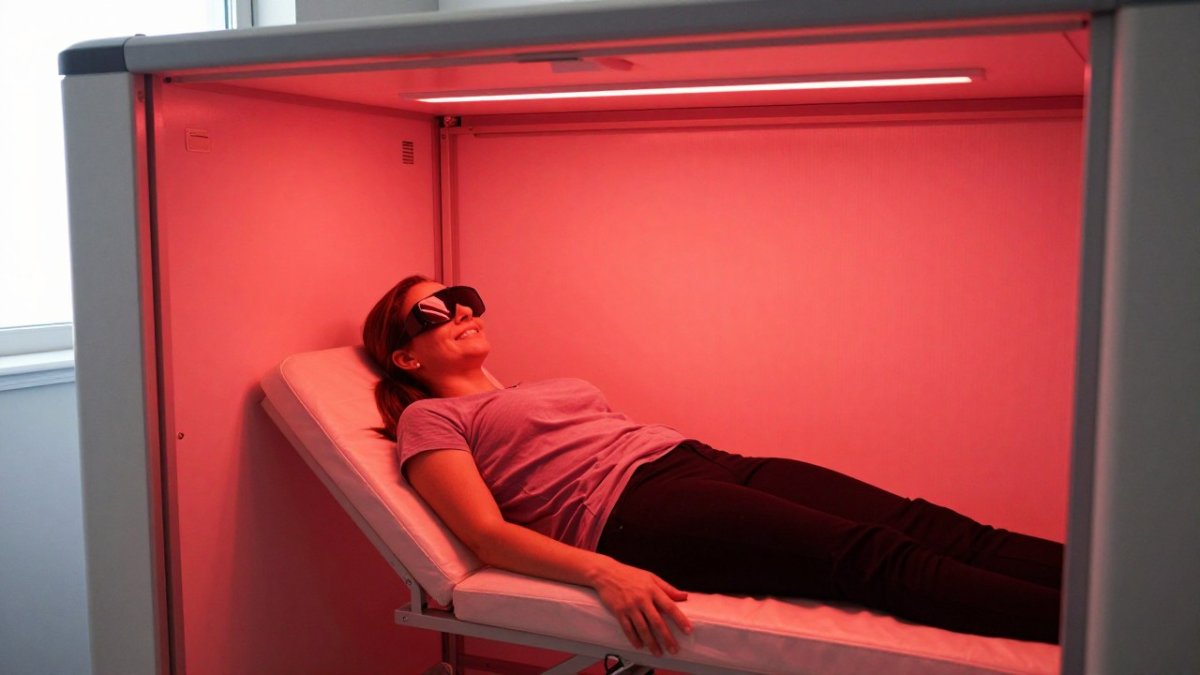
For readers who want full-body coverage and consistent dosing rather than a handheld device, the Trifecta Red Light Bed is our in-studio option. It removes the guesswork around exposure time.
Red Light Therapy Mask vs Full-Body Panel: Which Fits Your Goal
A mask and a full-body panel solve different problems. A red light therapy mask is best for facial skin concerns: wrinkles, tone, and collagen. A full-body panel covers larger areas and reaches joints and muscles a mask cannot.
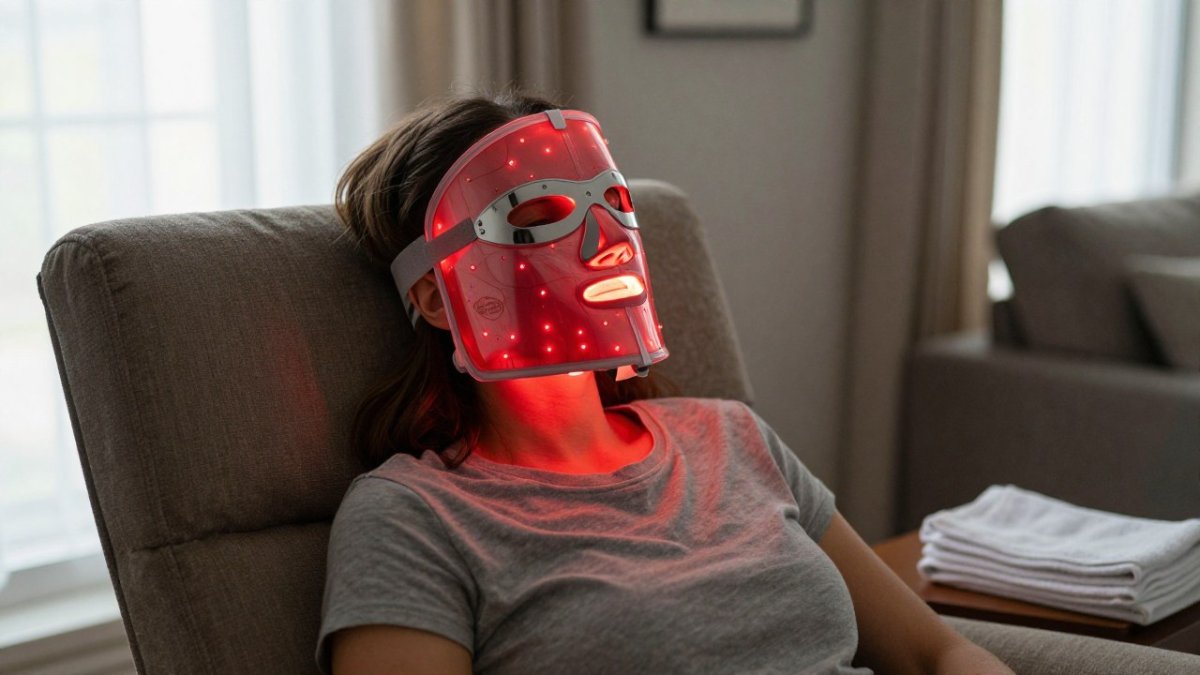
Choose a mask if your goal is skin rejuvenation on the face and you want something portable. Choose a panel or bed if your goal is pain relief, recovery, or treating the whole body.
| Option | Best For | Coverage | Trade-off |
|---|---|---|---|
| Mask | Facial skin, wrinkles | Face only | No joint or muscle reach |
| Handheld | Targeted spots | Small area | Time-consuming |
| Full-body panel/bed | Pain, recovery, whole body | Full body | Higher cost, less portable |
Weighing the Pros and Cons Before Your First Session
The potential pros include being non-invasive, drug-free, and generally mild in side effects, with possible uses for both skin and recovery goals. The cons include that results take consistency, evidence varies by claim, and at-home devices vary in quality.
Pros and cons at a glance:
- Pros: non-invasive, drug-free, supports collagen and recovery, mild side effects
- Cons: gradual results, mixed evidence for some claims, device quality varies, cost adds up
If you are considering it, you can book an appointment to discuss whether it fits your goals.
The challenge is simple: most people either overpay for weak devices or give up before results show. Trifecta Light Center takes the guesswork out with full-body red light therapy, ionized alkaline water hydration, and tools like Pnoe breath analysis and Styku 3D body scanning to track how your body responds. Get started with Trifecta Light Center and build a routine that fits your goals.
Frequently Asked Questions
Is there any downside to red light therapy?
Reported side effects include temporary redness, mild skin irritation, and short-lived discomfort after a session. Blistering has been reported and is usually tied to overexposure or a device used longer than its instructions allow. The bigger downside is spending money on a device that delivers the wrong wavelength or dose and produces no measurable improvement. Buy or book based on stated wavelength, irradiance, and treatment time rather than marketing claims.
Who should avoid red light therapy?
Talk to a doctor first if you take medications that cause photosensitivity, such as certain antibiotics or acne drugs. People with a history of skin cancer, active skin infections, or open wounds in the treatment area should get medical clearance before starting. Pregnant users and anyone treating the eye area should also check with a clinician. Red light therapy is generally low-risk, but it is not a substitute for medical care for a diagnosed condition.
Is red light therapy safe to use at home?
At-home use is generally considered safe when you follow the device instructions on distance, session length, and frequency. Two rules matter most: wear the eye protection the device provides, and do not extend sessions to try to speed up results. More exposure does not mean better results, and overuse is the most common route to irritation or blistering. If a device lists no wavelength or irradiance, treat that as a warning sign.
Can red light therapy cause cancer?
Red and near-infrared light therapy does not use ultraviolet light, which is the part of sunlight linked to skin cancer. Current research has not shown that red light therapy causes cancer, but long-term human data is still limited, so no one can call it proven safe over decades of use. That is a reason to follow dose instructions and get professional guidance if you have a personal or family history of skin cancer.

