
Last Updated: November 20, 2026
Quick Summary
To find red light therapy near you, search Google Maps for the term within a radius you would realistically travel, then confirm each listing actually offers the treatment. Call providers to ask what device they use and how sessions are run before booking.
- Run the search with alternate terms like photobiomodulation and LED light therapy, since providers describe the service differently.
- Confirm each listing offers red light therapy, because some listings are infrared saunas or other services.
- Ask what wavelengths the device emits and how long a session runs.
- Confirm safety screening, eye protection and staff qualifications before your first session.
- Speak with a physician first if you take photosensitizing medications or are pregnant.
Table of Contents
- What Red Light Therapy Involves and Who Uses It
- Searching for Red Light Therapy Providers Near You
- Checklist for Vetting a Red Light Therapy Studio
- How Long Is a Red Light Therapy Session and How Often to Go
- Red Light Therapy Cost Per Session and How to Compare Pricing
- Red Light Therapy Side Effects and When to Talk to a Clinician
- Booking Your First Red Light Therapy Visit
- Frequently Asked Questions
What Red Light Therapy Involves and Who Uses It
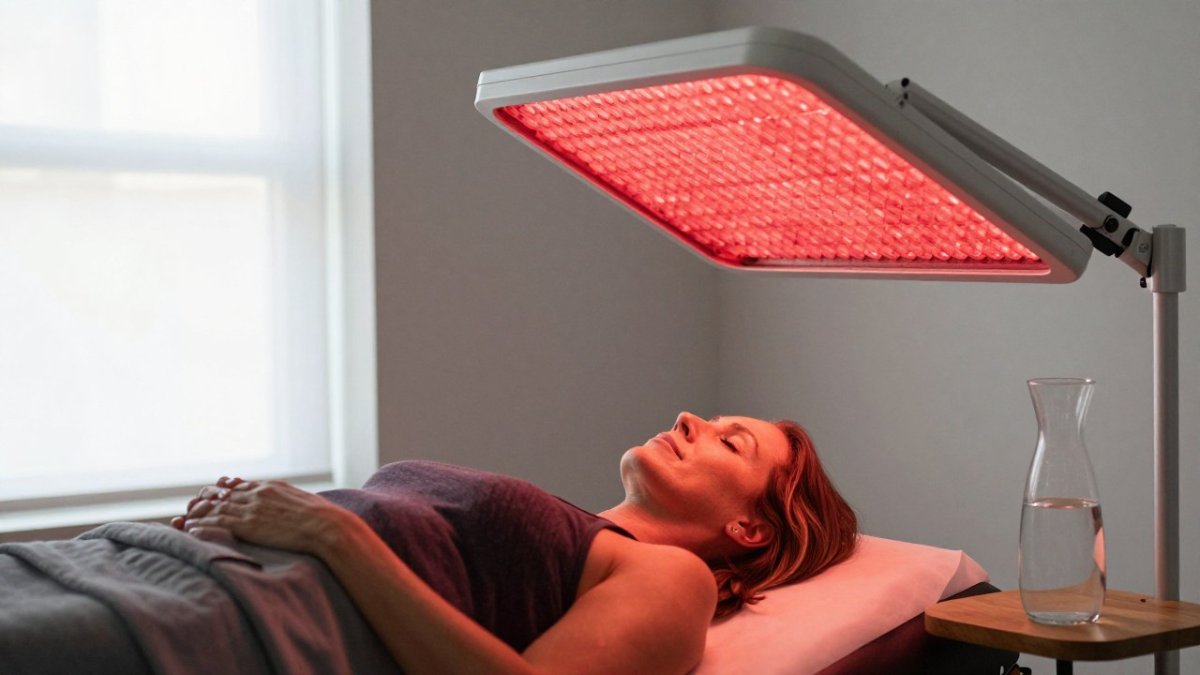
Red light therapy is a noninvasive treatment that exposes the skin and underlying tissue to red and near-infrared light. Practitioners and wellness studios use it for skin health, muscle recovery and joint comfort.
The people who seek out red light therapy tend to fall into a few groups. Athletes often look for recovery support between training sessions. Busy professionals ask about stress and fatigue management without medication.
Be cautious about what any single session can promise. Research on red light therapy is still developing, and results vary by person, device and protocol.
Searching for Red Light Therapy Providers Near You
Searching “red light therapy near me” returns a mix of studios, medical spas, chiropractic offices, dermatology practices and home-device sellers. Most of those results are listings, not guidance, so the work of comparing them falls to you. The process below works whether you are searching a ZIP code, a suburb or a downtown district, and it helps you avoid booking a session at a place that does not offer the treatment you want.

!Woman in athletic wear checking directions on her smartphone outside a bright wellness studio entrance
Step 1: Search by ZIP Code and Map Radius
Open Google Maps and search “red light therapy” while the map is centered on your home, office or another address you can reach easily.
Run the same search with alternate terms, because providers describe the service differently: “red light therapy,” “photobiomodulation,” “LED light therapy,” “low-level light therapy” and “infrared light bed.” Each phrase surfaces a different set of listings.
Watch out: a listing that appears under “red light therapy” may be an infrared sauna studio, a tanning salon with a red-light bed, or a chiropractic office that uses a handheld device.
Step 2: Verify the Listing Actually Offers Red Light Therapy
Open each listing and read the service description, not just the category tag. Look for the device type (bed, panel, handheld), the treatment area (full body or localized), and whether the session is supervised.
Call or message the provider with one direct question: “Do you offer red light therapy sessions, and what device do you use?” A provider that answers clearly is easier to compare than one that deflects. If the answer is “we have an infrared sauna,” you have learned that the listing is not a match.
Step 3: Check Hours, Addresses and Service Areas
Confirm the address before you drive anywhere, and note whether the studio is in a medical building, a plaza or a standalone space, since parking and access differ. Verify posted hours against the provider’s own website, because map listings sometimes lag behind schedule changes.
Some providers operate across several locations or offer visits outside their studio. Read the service area carefully so you know whether you are booking at the studio or somewhere else. Call ahead if the listing is unclear, and confirm the provider can accommodate your schedule before you commit.
Step 4: Compare the Shortlist on the Same Criteria
Once you have three to five verified providers, put them on the same basis: device type, session length, treatment area, staff supervision, posted pricing model and cancellation terms. A studio that publishes its protocol and policies is usually easier to trust than one that answers only by phone. Save the two or three most promising options and move to the vetting checklist below.
Checklist for Vetting a Red Light Therapy Studio
Use this checklist on every studio you are considering. A provider that answers these questions openly is usually easier to trust than one that deflects. The goal is to compare providers on the same criteria, not to find a single “best” device.
- Device type and treatment area. Ask whether they use a full-body bed, a panel array or a handheld device, and whether the session covers the whole body or a targeted area. A full-body bed and a localized panel are different services with different session lengths and pricing.
- Wavelength range. Ask what wavelengths the device emits. Red light and near-infrared light sit in different ranges and are often used for different goals, so a provider should be able to state the range rather than describe the device only as “red light.”
- Session protocol. Ask how long a session runs, how many sessions are typically recommended, and how the protocol is adjusted for each client. A provider that uses the same setting for everyone is telling you something about its approach.
- Safety screening. Confirm they ask about medical history, medications, photosensitivity and pregnancy before the first session. A provider that skips screening is a reason to keep looking.
- Staff qualifications. Ask who runs the sessions and what training or credentials that person holds. Verify any credential against the issuing body’s own website rather than taking the claim at face value.
- Eye protection and hygiene. Confirm they provide eye protection and clean equipment between clients. Ask how the device is cleaned and how often.
- Claims. Be wary of any provider that promises cures, guarantees specific results or uses the phrase “completely safe.” Red light therapy is generally described as low-risk, but no treatment is risk-free for everyone.
- Written policies. Ask for cancellation, refund and package terms in writing before you pay. Terms that exist only in a phone conversation are hard to enforce later.
- Clinician referral. A good provider will tell you when to speak with your doctor first, especially if you take photosensitizing medications, have a history of skin cancer or other skin conditions, are pregnant, or have an implanted medical device.
Distinguish Red Light From Other Light and Heat Services
Many listings mix red light therapy with LED light therapy, infrared saunas and general “light therapy.” They are not the same service. An infrared sauna heats the body through infrared radiation and is used for relaxation and sweating; it is not a substitute for a red light session. LED light therapy can refer to a range of devices, some of which are not red light at all. Ask the provider to describe exactly what the device does and what the session involves, and treat a vague answer as a reason to compare another option.
Questions to Ask About Equipment and Protocols
Bring a short list of questions to the first call or visit: What device do you use, and what wavelengths does it emit? How long is a session, and how many do you typically recommend? Is the session supervised, and who supervises it? What does a single session cost, and what does a package cost per session? What are the cancellation and refund terms? A provider that answers these clearly gives you a fair basis for comparison; one that avoids them gives you a reason to keep searching.
How Long Is a Red Light Therapy Session and How Often to Go
A typical red light therapy session lasts somewhere between about 10 and 20 minutes, though the exact length depends on the device and the treatment area. Ask the provider for the session length in writing before you book.
Frequency is where many people get confused. Some studios recommend a short series of sessions per week at first, then taper to maintenance visits. Others offer memberships of various kinds.
Busy schedules matter here. A plan you can keep consistently usually beats an aggressive one you abandon after two weeks.
Red Light Therapy Cost Per Session and How to Compare Pricing
Pricing for red light therapy varies widely and depends on the studio, the device, the session length and whether you buy single visits or a package. Pricing depends on the studio, the device, the session length and whether you buy single visits or a package.
When comparing providers, put the numbers on the same basis. Compare the cost of a single session, the cost per session within a package, and any membership fees.
Pricing varies by studio, device, session length and whether you buy single visits or a package, so compare the options on the same basis.
| Pricing factor | What to compare | Why it matters |
|---|---|---|
| Single session | Cost of one visit | Baseline for trying a provider |
| Package | Cost per session within the package | Often changes the per-visit price |
| Membership | Recurring monthly fee | Adds to total cost over time |
| Package expiry | How quickly the package expires | Short windows can waste unused visits |
| Visits needed | Number of visits to see a result | A low price can cost more if many visits are required |
Red Light Therapy Side Effects and When to Talk to a Clinician
Red light therapy is generally described as low-risk, but that does not mean it is risk-free for everyone. Reported side effects are usually mild and can include temporary skin redness, warmth or irritation.
Speak with a physician before starting if you take photosensitizing medications, have a history of skin cancer or other skin conditions, are pregnant, or have an implanted medical device. Anyone managing a chronic condition such as osteoarthritis should discuss treatment options with their clinician rather than relying on a session alone.
Booking Your First Red Light Therapy Visit
Once you have compared a few providers, choose the one whose answers were clearest and whose policies fit your schedule. Bring a list of your medications and any medical conditions so the staff can screen you properly. Arrive a few minutes early to review the session with the team.
Ready to try a session? You can schedule your session with Trifecta Light Center and ask any questions before your first visit. If you want to check the claims and credentials behind any studio you are considering, our resources can help you start that review.
For a deeper look at the evidence, read whether red light therapy and alkaline water are scientifically supported, or see what the research says about red light therapy for osteoarthritis symptoms. If weight goals are your motivation, our step-by-step guide to using red light therapy for weight loss explains how sessions fit into a plan.
Frequently Asked Questions
How much does a red light therapy session cost?
Pricing depends on the studio, the type of session, package size, and whether you buy a membership. Check the studio’s website or contact the studio directly for current rates and package options. When comparing, look at the price per session, whether a package or membership lowers that cost, and what is included, . Compare the total cost over the number of visits you realistically expect to make, rather than the price of a single session alone.
Are there side effects of red light therapy?
Red light therapy is generally non-invasive, and people commonly report few side effects. Some users notice temporary warmth, mild eye discomfort if protective eyewear is not used, or skin sensitivity, especially with photosensitizing medications. Red light therapy is not a substitute for medical care. If you have a medical condition, are pregnant, take medications that increase light sensitivity, or have concerns about symptoms, consult a qualified clinician before booking a session.
How do I verify that a red light therapy provider is reputable?
Start by confirming the studio’s address, hours, and contact details, and read recent reviews on several platforms. Ask what equipment the studio uses, how it is maintained, and whether staff are trained to explain treatment protocols and contraindications. A reputable provider will answer questions about safety directly, will not promise cures, and will encourage you to speak with a clinician if you have a health condition. Avoid any provider that guarantees specific results.
How long is a red light therapy session?
Session length varies by device type and treatment area. Ask the studio how long a typical session lasts for the treatment you are considering, and how many visits it recommends in a given week or month. Keep in mind that session length alone does not determine how well a treatment works.

