
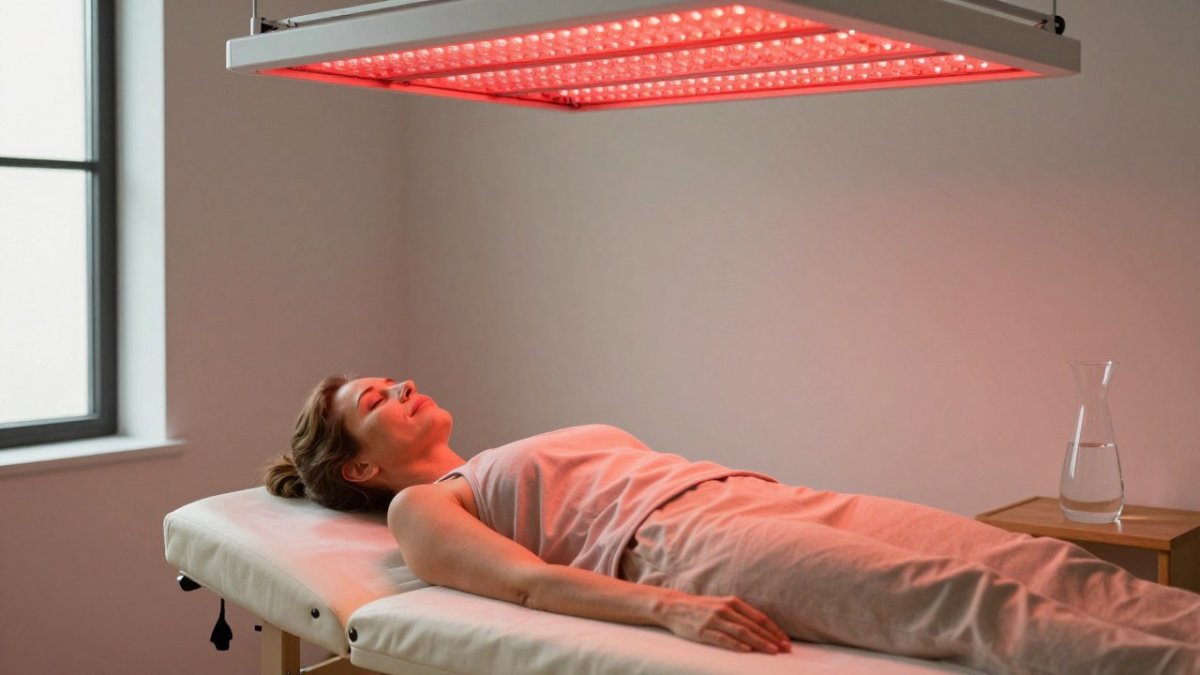
Quick Summary
Red light therapy for weight loss is a proposal, not established science. Some small studies report modest reductions in localized fat thickness, but well-controlled human evidence is limited, and no trial has shown meaningful sustained weight loss from red light therapy alone.
- Red light (630 to 670 nm) and near-infrared light (810 to 850 nm) are the wavelengths most often studied.
- Most of the proposed mechanism comes from laboratory and animal work, not human trials.
- Sham-controlled trials narrow the gap between active treatment and placebo.
- Localized fat loss differs from overall weight loss, which depends on total energy balance.
- Track a baseline waist measurement and re-measure after six to eight weeks under the same conditions.
Table of Contents
- How Red Light Therapy Is Proposed to Affect Fat Cells
- What the Evidence Shows for Fat Reduction and Weight Loss
- Localized Fat Loss Versus Overall Weight Loss: What Changes on the Scale
- Red Light Therapy Weight Loss Before and After: Realistic Expectations
- How Often Should You Use Red Light Therapy for Weight Loss?
- Red Light Therapy for Weight Loss at Home: A Practical Protocol and Device Checklist
- Choosing the Best Red Light Therapy for Belly Fat and Booking Your Next Step
- Frequently Asked Questions
How Red Light Therapy Is Proposed to Affect Fat Cells
Red light therapy for weight loss rests on a simple proposal: certain wavelengths of red and near-infrared light may change how fat cells behave. Light in the red range, roughly 630 to 670 nanometers, and near-infrared light, around 810 to 850 nanometers, are the wavelengths most often studied for this purpose (What to Look for in Red Light Therapy: A Product Guide Backed by Science). (Source: photobiomodulation)
The proposal runs through the cell’s energy system. Researchers suggest that light absorbed by the mitochondria may stimulate cytochrome c oxidase, an enzyme involved in producing ATP, the cell’s main energy currency. For a deeper look at the cellular energy science, read Power Up Your Mitochondria With Red Light Therapy.
Keep in mind that most of this mechanism comes from laboratory and animal work. Human results are far less clear.
Fat-cell response and triglyceride release
The most discussed proposal is that light may prompt fat cells to release triglycerides, the stored fats they hold. Some small studies have reported reductions in fat-layer thickness after treatment, while others found little or no difference compared with a placebo.
A released triglyceride still has to be used or cleared by the body. Without diet changes or increased activity, that fat may not leave the body at all.
Potential effects on metabolism and cellular energy
Beyond fat cells, the proposal extends to metabolism. If light improves mitochondrial function, cells may have more energy available for normal activity. Proponents say this could support recovery and general vitality.
Still, a higher energy output at the cellular level does not automatically mean the body burns more calories overall. Metabolic change from light therapy has not been shown consistently in human trials.
What the Evidence Shows for Fat Reduction and Weight Loss
Most top-ranking articles on this topic summarize the research in one paragraph and move on.
A useful way to organize the human literature is by design and outcome:
- Uncontrolled before-and-after studies. These are the weakest design. Participants know they are being treated, technicians know what they expect to see, and measurements are often taken by the same staff who delivered the treatment. Reported reductions in circumference or fat-layer thickness in these studies should be treated as hypothesis-generating, not confirmatory.
- Sham-controlled trials. Here participants are randomized to an active device or an identical-looking device that emits no therapeutic light. These are more informative because they control for expectation and measurement bias. A common pattern in this literature is that the gap between active and sham treatment narrows once sham controls are added, sometimes to the point of statistical non-significance.
- Trials with objective imaging. Studies that measure fat-layer thickness with ultrasound, calipers applied by a blinded assessor, or other imaging are more credible than studies relying on tape-measure circumference alone, because circumference also changes with posture, hydration, and bloating.
Effect sizes in the better-controlled trials tend to be modest, on the order of small changes in localized fat thickness or circumference over several weeks of treatment, with wide variation between individuals.
What the evidence does not show is meaningful, sustained weight loss from light therapy alone.
The human evidence varies a great deal by study design, so the table below sorts the main categories and what each can tell a reader.
| Study design | Key limitation | Reliability |
|---|---|---|
| Uncontrolled before-and-after | No control group; expectation bias | Weakest; hypothesis-generating |
| Sham-controlled trials | Gap often narrows with sham control | More informative |
| Objective imaging measures | Circumference alone is less reliable | More credible |
| Body weight or fat mass endpoints | Changes typically small, often not significant | Most important for the scale |
Localized Fat Loss Versus Overall Weight Loss: What Changes on the Scale
Localized fat loss and overall weight loss are different outcomes, and confusing them leads to disappointment.
Red light therapy is most often proposed for contouring, meaning slightly smaller measurements in a treated area. A person may notice a reduced waist measurement while their total weight barely changes.
Sustainable weight loss still depends on a calorie deficit maintained through diet and exercise. Light therapy may complement those habits, but it does not replace them.
Red Light Therapy Weight Loss Before and After: Realistic Expectations
Before-and-after photos from clinics and manufacturers can make results look dramatic. Lighting, posture, hydration and clothing all change how a body appears in a photo, and selected images rarely represent typical outcomes. (Source: U.S. Food and Drug Administration)
Realistic expectations look more like this: small changes in circumference over several weeks, if any, and results that vary widely between individuals.
If you see no change after a reasonable trial period, that is useful information. It may mean the approach is not right for you.
How Often Should You Use Red Light Therapy for Weight Loss?
There is no established optimal schedule for red light therapy aimed at fat reduction, and any article that gives you one universal protocol is overstating what is known. What you can do is understand how dose is described, choose a device whose specifications are stated clearly, and track your own use so you can judge whether it is worth continuing.
How dose is actually described
In photobiomodulation research, dose is not just “minutes.” It is a product of irradiance (power delivered per unit area, usually in mW/cm²), treatment time, and the distance between the device and the skin.
Session frequency in published studies has ranged widely, often from two to five sessions per week over several weeks to a few months, with session durations commonly around 10 to 30 minutes per treated area. No single combination has been shown superior in well-controlled human trials.
A practical at-home protocol
Because no universal dose is established, the sensible approach is a structured self-trial rather than a fixed prescription:
- Establish a baseline. Measure waist circumference at a consistent point, for example, at the navel, first thing in the morning, before eating, using a tape that sits snug but not tight. Record it three times and average. If you have access to a body-composition scale, record that too, since circumference and fat mass can move independently.
- Read the device manual and follow it. Manufacturer instructions are the only dose guidance specific to your device. Do not exceed the stated session time or frequency in an attempt to speed results.
- Standardize your sessions. Use the same distance, the same body position, and the same time of day where possible. Consistency is what makes your own results interpretable.
- Log each session. Note date, duration, body area treated, and any skin reaction. A simple notebook or phone note is enough.
- Set a defined trial period. Six to eight weeks is a common window in the research. At the end, re-measure under the same conditions as your baseline and compare. If nothing has changed, that is useful information, it suggests the approach is not working for you, and you can stop rather than continue spending time and money.
- Keep diet and activity steady. If you change your eating or exercise at the same time, you will not be able to tell what the light therapy contributed.
Evaluating a device before you buy
Use these criteria:
- Wavelengths stated clearly. Red light in the roughly 630 to 670 nm range and near-infrared around 810 to 850 nm are the bands most studied. A device that lists only “red light” without a wavelength is hard to evaluate.
- Irradiance in mW/cm², with a stated measurement distance. Without a distance, an irradiance figure is not meaningful.
- Treatment area. A small panel treats a small area; larger panels cover the abdomen or thighs more evenly. Match the device to the area you intend to treat.
Watch out: consumer-device claims frequently cite clinical studies performed with different equipment, higher irradiance, or different treatment schedules, so a device’s marketing citation does not guarantee your device delivers the studied dose.
Safety and who should check first
Side effects of light devices can include mild skin redness or irritation. Eye protection is advised, and you should not stare into the light. Anyone who is pregnant, takes photosensitizing medications (some antibiotics, acne treatments, and certain herbal supplements among them), has a history of skin cancer or photosensitivity disorders, or has a medical condition affecting the skin should consult a clinician before starting.
Cost and realistic value
At-home devices range from small panels to larger units, while in-clinic sessions are priced per visit and require repeated appointments. Home devices offer convenience but vary widely in output and quality; clinical sessions offer professional guidance but can add up over time. Given the modest and uncertain evidence for fat reduction, it is reasonable to treat any purchase as an experiment with a defined budget and a defined trial period rather than a guaranteed investment.
Red Light Therapy for Weight Loss at Home: A Practical Protocol and Device Checklist
Home devices range from inexpensive panels to larger professional-grade units. Before you buy, check the wavelength, power output (irradiance), treatment area and whether the manufacturer publishes independent test data.
Use this checklist when evaluating a device:
- Wavelengths: Look for red (around 630 to 670 nm) and near-infrared (around 810 to 850 nm) listed clearly.
- Irradiance: Confirm the output in mW/cm², and whether it is measured at a stated distance.
- Safety features: Automatic timers, eye protection guidance and certification marks.
A basic at-home protocol might look like this: track a baseline waist measurement, use the device on a consistent schedule for six to eight weeks, and re-measure under the same conditions. Pair the routine with your usual diet and activity so you can see what the light therapy adds, if anything.
Anyone with a medical condition, who is pregnant, or who takes photosensitizing medications should check with a clinician first.
Choosing the Best Red Light Therapy for Belly Fat and Booking Your Next Step
Choosing a provider or device starts with clear questions. Ask about wavelengths, irradiance, treatment protocol and what outcomes the provider can realistically promise.
Clinical treatments and at-home devices each have trade-offs. Clinical sessions offer professional guidance, but they require repeated visits. Home devices offer convenience and lower ongoing cost, but output and quality vary widely, so verifying specifications matters more.
At Trifecta Light Center, our team offers full-body red light therapy as part of a broader wellness approach. If you want to explore whether this option fits your goals, you can book an appointment to discuss your situation with our staff. For a closer look at the device itself, see our red and near-infrared light therapy bed and how it is used.
Frequently Asked Questions
Does red light therapy actually help with weight loss?
The evidence is limited. Some small studies report modest reductions in waist circumference or localized fat thickness after repeated sessions, but these studies are short, often small, and frequently funded or designed in ways that make results hard to generalize. Red light therapy has not been shown in rigorous trials to produce meaningful, sustained weight loss on its own. Think of it as a possible adjunct to diet and exercise, not a replacement, and discuss expectations with a qualified professional before starting.
How often should you use red light therapy for weight loss?
Protocols in published research typically involve sessions several times per week over several weeks, but no single frequency has been shown to be optimal. Device manufacturers publish their own recommendations, which vary widely. Follow the instructions for your specific device, avoid exceeding recommended session lengths, and allow time for any changes to appear. If you are unsure how often to use a device, a consultation with a qualified provider can help you set a reasonable plan.
Is red light therapy for weight loss safe to use at home?
Some people may experience effects from light devices when used as directed, including skin irritation or headaches. Eye protection is commonly recommended, and some people may experience skin irritation or headaches. Those who are pregnant, have photosensitive conditions, take photosensitizing medications, or have a history of skin cancer should speak with a physician before using any light device. Stop use and seek medical advice if you notice unusual symptoms.
Can red light therapy replace diet and exercise?
No. Current evidence does not support red light therapy as a replacement for a calorie deficit, physical activity, or other established approaches to weight management. Any benefit to body contouring or fat-layer thickness should be viewed separately from sustained weight loss, which depends mainly on energy balance and long-term habits. Use light therapy, if at all, as a supplement to a plan that already includes nutrition and movement.

